ChatGPT
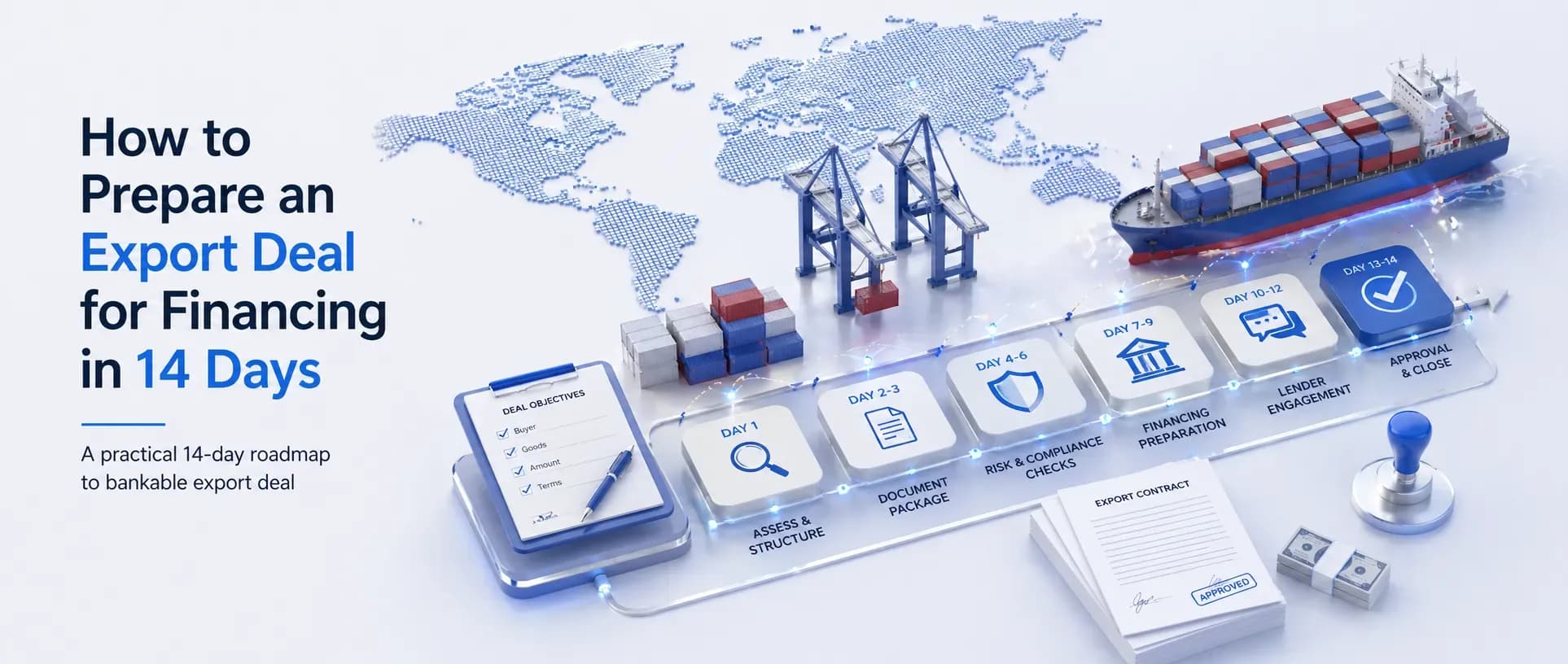
How to Prepare an Export Deal for Financing in 14 Days
To keep your bank from freezing your deal for two months, you have 14 days. Here's a five‑block action plan.

Time is currency in international trade. When you've found the buyer and signed the contract, the last thing any exporter expects is a two‑month delay because the bank "rejected" your financing documents. The stakes are high: idle money kills margins.
We've put together a plan to get your export deal ready to submit to a bank or financial institution. Just 14 days to compile a "dossier" that will pass on the first try.
A 14‑Day Calendar: Who Does What
Success depends on four key players working in sync: a lawyer, an international trade manager, a financial officer, and a logistics specialist. Here's how the stages break down by day.
Week 1: Legal Cleanliness and the Contract
Days 1–2. Lawyer + Financial Officer.
Task: Check not just for debts, but also against sanctions lists (SDN, sectoral sanctions). The financial officer checks the buyer's country against the bank's blacklists.
Outcome: A conclusion that payments will go through and that no over‑compliance will be triggered.
Days 3–4. Lawyer + Trade Manager.
Task: Adapt the invoice and contract to meet future financing requirements. Important: the contract must already include terms for bank transfers (if post‑financing) or specify a letter of credit.
Outcome: A contract that clearly shows the amount, currency, delivery basis, and deadlines.
Week 2: Documents and Numbers
Days 5–7. Financial Officer (Payment Infrastructure).
Task: Open a foreign currency account (if needed), handle the transaction passport (if relevant for your jurisdiction), or register the contract with an authorized bank.
Outcome: An account ready to receive the tranche.
Days 8–10. Logistics + Financial Officer (Performance Proof).
Task: Plan the route. If financing is tied to shipment, you'll need bills of lading or railway consignment notes that the bank accepts.
Outcome: Confirmation that the documents will meet the terms of collection / letter of credit.
Days 11–12. Lawyer + Trade Manager (Document Package).
Task: Assemble documents strictly according to the checklist. Check for technical errors (typos in dates, mismatched stamps).
Outcome: A complete, error‑free package.
Days 13–14. Financial Officer (Submission).
Task: Prepare the application and send it to the bank/fund.
The 5 Mandatory Document Blocks
A bank sees a deal as an assembly kit. If one part is missing or loose, financing stops. Here are the five blocks:
1. The "Counterparty" Block (Who Pays). The bank isn't just funding you; it's trusting your buyer.
What you need: the non‑resident's registration documents (apostilled / legalized, with a notarized translation).
Important: The "extract from the commercial register" must be fresh (no older than 3‑6 months).
2. The "Contract" Block (The Deal's Foundation). The foreign trade contract is your bible. No amendments are possible once financing begins.
What you need: the contract with all specifications and addenda.
Important: A clear payment schedule and termination conditions. Banks prefer well‑defined liability clauses.
3. The "Logistics" Block (Goods in Transit). Proof that the goods are real and moving toward the buyer.
What you need: invoices, packing lists, CMR / TIR / bills of lading.
Important: All documents must be issued to the exact buyer named in the contract. Discrepancies in company names are fatal.
4. The "Payment Infrastructure" Block (How Money Moves). The framework for funds to flow.
What you need: a bank card with specimen signatures, a bank account agreement.
Important: The contract's currency and the payment currency must match or be convertible without loss.
5. The "Performance Proof" Block. The basis for the bank to release funds to you or to the buyer.
What you need: an acceptance certificate signed by the buyer, or a survey report (SGS inspection certificate, etc.).
Important: Either shipping documents with a border‑crossing stamp.
7 Main Reasons Documents Get Rejected — and How to Fix Them
Even a good contract can be sent back. Here are the top seven reasons for rejection and how to prevent them.
1. Currency Mismatch Between Contract and Loan.
How it looks: The contract is in yuan, but you're asking for a loan in rubles secured by future revenue. The bank can't hedge the risk.
Fix: Build a multi‑currency clause into the contract, or structure the financial model in the loan currency from the start.
2. Vague Payment Deadlines.
How it looks: Payment from the buyer is due, say, "within 90 days of shipment". The bank sees this deferral as critical if you lack working capital.
Fix: If you need the bank's money immediately, insist on a letter of credit or prepayment, or structure the deal as factoring (financing against assignment of receivables).
3. Unclear Incoterms Delivery Basis.
How it looks: EX‑WORKS is specified. The bank can't tell who owns the goods in transit or who to claim against if cargo is lost before crossing the border.
Fix: For financing, it's better to choose terms like FOB, CIF, or DAP, where risk transfer is clearly documented by a bill of lading or transport note.
4. Disconnect Between Contract, Invoice, and Payment.
How it looks: The contract says one price, the invoice shows another (due to a discount or bonus). The bank sees a possible attempt to move currency illegally.
Fix: Formalize any changes with addenda to the contract before issuing the invoice.
5. Incorrect Document Translation.
How it looks: The buyer's incorporation documents are translated by "Romashka Ltd.", but the contract transliterates the name differently.
Fix: Hire a notarial translator, or ensure consistent transliteration (always match the company's passport / registration exactly).
6. Missing Stamps on Specifications.
How it looks: A specification is signed with a facsimile or sent as a scan without a signature. The Central Bank of Russia considers such a document invalid for currency control.
Fix: Exchange signed and stamped scans; originals can come later, but at the application stage, require a properly signed document.
7. VAT Chain Breaks (for Russia).
How it looks: You bought goods from a supplier on the Simplified Tax System (no VAT) and are now exporting them with the right to reclaim VAT from the budget. The bank (and the tax authority) may suspect a scheme.
Fix: Prepare an explanatory note justifying the pricing and proving the supplier's reality (documents: warehouse photos, transaction passports with them).
Preparing an export deal for financing isn't about filling out a form — it's about assembling a complex mechanism. By following this 14‑day calendar and checking your package against the five blocks, you'll boost your chances of getting funded on the first try. Remember: a bank doesn't finance a company — it finances a specific deal. Make that deal flawless.
At EDENEX DFTP, we've turned this nightmare on its head. Our document submission and verification process takes as little as one hour — and in rare cases, up to 24 hours. Once everything checks out, you receive funding within 24 to 120 hours. No waiting weeks. No drowning in paperwork. Just capital, when you need it.