ChatGPT
Legal Enforceability of a Deal Before Raising Capital: How Not to Lose Money at the Start
Without protection in your contract, recovering investments in a startup is nearly impossible. We explain which clauses will ensure you get your money back.

The early stage of a startup is a time of enthusiasm, belief in an idea, and vague agreements. Often, the first deals with contractors or even future co-founders are made "verbally." When it comes time to get your money back, the legal enforceability of the contract becomes the only shield for an investor or founder.
Let's break down which contract clauses become critical for recovering funds and where disputes most often arise.
Key Contract Clauses That Determine the Fate of Your Money
For a deal to be enforceable and for you to have leverage in case of failure, the contract must contain not just the "will of the parties," but clear, measurable criteria. Here are the four pillars on which the return of financing rests.
Subject Matter of the Contract
A common mistake at the start is describing the subject matter in vague terms: "Website development," "Marketing support," "Consulting services."
For a deal to be enforceable, the subject matter must be unique and specific.
How it should be done: not just "Website development," but "Creation of a landing page for product X, consisting of a header, a pricing block, and a lead capture form, using the Figma layout at link Y."
Why this is important: if the subject matter is vague, it's impossible to prove in court that the work was done poorly or not in full. The judge is not obligated to figure it out; they look at the text of the contract. No clear description means no obligation to return the money.
Terms and Conditions of Payment
Payment terms must be synchronized with the stages of work acceptance.
Advance payment vs. Post-payment: before raising capital, contractors often demand 100% prepayment. Legally, this is the riskiest scenario. If the contract is not fulfilled, you can only recover the advance through court, and only if you can prove the work wasn't done.
Tying payment to events: the ideal wording for the client is payment within 5 days after signing the acceptance certificate. If the contractor insists on an advance, the contract must include a clause granting the client the right to demand the return of the unearned advance in case of missed interim deadlines.
Liability
The level of liability determines how easily a partner might decide to "dump" the project.
Penalties: a clause on fines for delay (e.g., 0.1% of the contract value per day) disciplines the contractor. But the main point is not so much a way to get rich, but a tool for leverage. Seeing the debt grow, the contractor is more likely to settle.
Fine for withdrawal: it's important to stipulate liability for an unjustified withdrawal from the contract by the contractor, especially if you have already paid for materials or a domain.
Procedure for Confirming Performance
This is the most underestimated clause. Many startups operate without signing closing documents, relying only on correspondence.
The contract must specify:
The form of the certificate: the work completion certificate is a document confirming that the service was rendered with quality and on time.
Acceptance deadlines: the client is obliged within (for example) 5 business days to sign the certificate or provide a reasoned refusal.
Consequences of silence: if the client does not respond within the deadline, the work is considered accepted. This is a standard condition that protects both sides from dragging out the process. If it is absent, the contractor may wait indefinitely for a signature, and the client may delay payment.
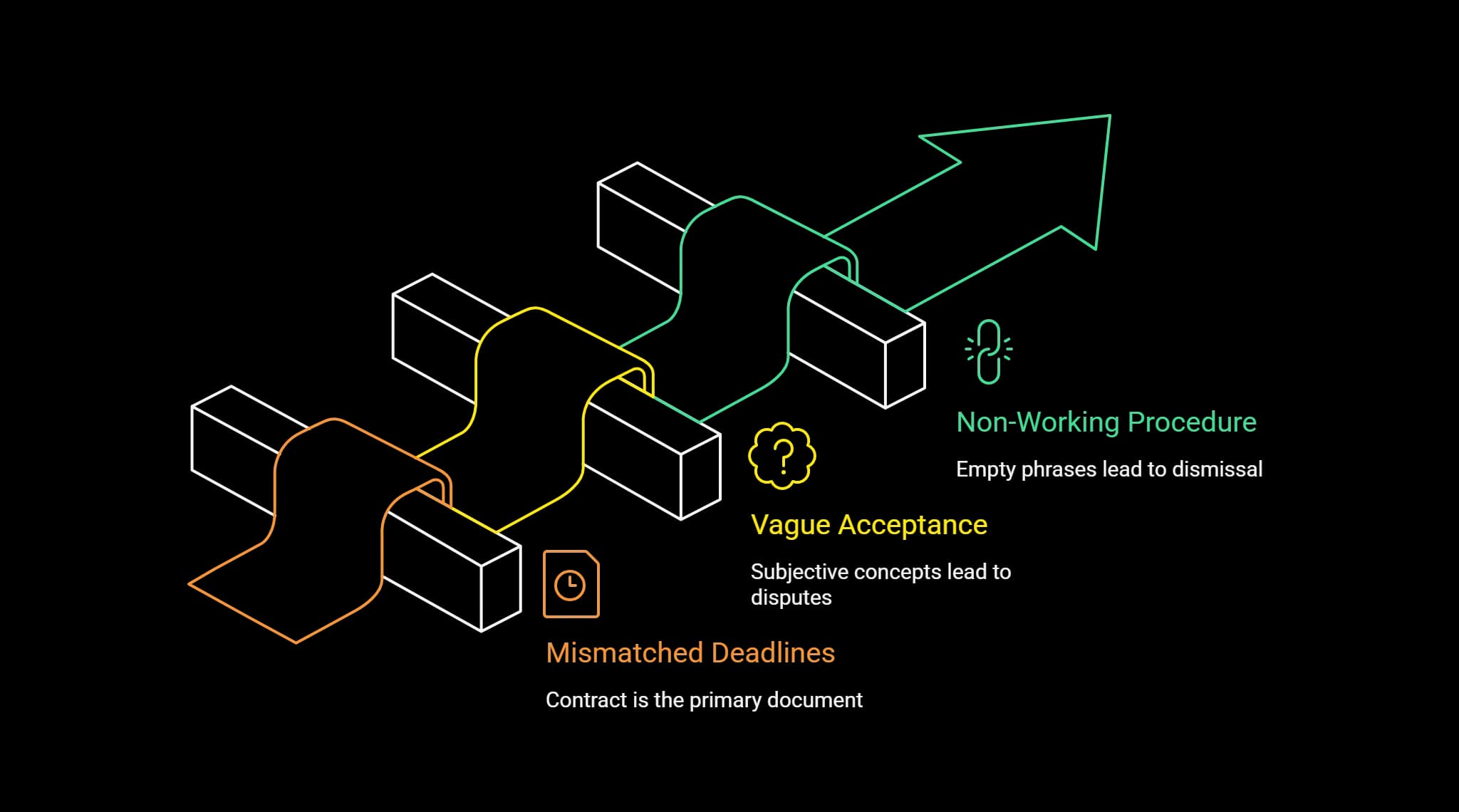
Where Disputes Arise: Three Trickiest Spots
Even if the contract is drawn up, the devil is in the details. At the initial stage, disputes most often arise from bureaucratic negligence.
1. Mismatch of deadlines in documents.
A classic situation: the contract states one deadline for the work, the technical specification states another, and in Telegram correspondence, a manager promises to "get it done faster by Friday."
The risk: the court will consider the contract as the primary document. Correspondence may be considered evidence, but only if the contract contains a reference stating that correspondence in messengers is official. Without such a reference, promises in chats are legally void.
2. Vague acceptance conditions.
Phrases like "the design should please the client" or "the website should be user-friendly" are a sure path to dispute. The concept of "pleasing" is subjective.
The solution: acceptance conditions must be objective. For a website — loading speed, absence of broken links, conformity to the layout. For texts — volume, uniqueness, absence of factual errors.
3. Non-working dispute resolution procedure.
Contracts often state: "All disputes are resolved through negotiations." This is an empty phrase.
A legally competent contract must contain a clear pre-trial claim procedure:
Deadline for considering a claim (e.g., 10 business days).
Method of sending the claim (registered mail with a return receipt, or email if permitted).
If this procedure is not followed, the court may dismiss the lawsuit without consideration, and you will lose months.
Napkin.ai
Minimum Legal Kit
If you are raising your first money (from business angels or as part of a pre-seed round) and want to protect yourself or, conversely, show the investor your legal maturity, your contract must contain this minimum:
Protocol of disagreements: any amendment to the contract must be recorded. If you agreed on a discount or special conditions, formalize this as an addendum or a protocol of disagreements. Verbal agreements are not worth a dime.
Personal data and VAT: if you work with individuals (freelancers), be sure to include a clause on their status as self-employed or sole proprietor. Otherwise, you will run into problems with the tax authorities when writing off funds, which could undermine the investor's confidence in your reporting.
Force majeure: a short but important clause releasing from liability in case of war, epidemics, etc. Without it, a contractor could blame rain as a reason for missing a deadline.
The legal enforceability of a deal before raising capital is not about mistrust, but about respect for money. Investors invest not only in an idea, but also in people who know how to manage that money. The clarity of a contract and the thoroughness of its money-back clauses are the first signal to an investor that you will not lose their capital in legal battles with unscrupulous contractors. Spend an hour drafting a competent contract now, so you don't waste hours and money on court cases later.