
created by Gpt
Sharia-Compliant Trade Finance: Models, Principles & Benefits
Islamic trade finance is not a niche — it's a fast-growing alternative to conventional lending. Discover how Murabaha, Ijarah, and partnership models work in practice, and why your business might need them to access Gulf capital markets.

Sharia-Compliant Trade Finance Models
The Islamic finance market is growing, and trade finance is its locomotive. In an environment where classical interest is prohibited and transaction instability is unacceptable, unique models have emerged. Let's break down how this works in practice
What is Sharia-Compliant Trade Finance?
It is a method of facilitating a purchase-sale or leasing transaction where a financial institution (Islamic bank) participates in a real trade operation without using interest on loans.
Key Differences from Classical Credit
The main difference between classical credit and Islamic financing lies not in the amount or term, but in the very nature of how the bank generates income.
Classical Credit: The bank lends money. The client repays the amount plus interest for the use of the money.
Sharia-Compliant Financing: The bank sells a good or leases an asset. The bank's income is a trade markup (profit) or rental payment, not a fee for deferred payment.
Strict Link to a Real Trade Transaction: You cannot abstractly receive 10 million rubles "to replenish working capital." The bank enters a transaction only if there is a third-party contract, invoice, and specification. In most models, money goes directly to the supplier, bypassing the client's current account.
Prohibition of Interest (Riba) and Speculation (Maysir): Interest is prohibited because it represents a guaranteed income without risk or effort. Speculation is prohibited because financing should not resemble gambling—transaction terms are fixed at the outset and do not depend on market volatility.
Core Principles of Islamic Finance
To understand the models, you need to know the four pillars on which they are built:
Prohibition of Riba (Usury): Any pre-determined excess of the debt amount over the loan amount is sinful. Income must result from sale, lease, or partnership, not from the temporary use of money.
Prohibition of Gharar (Uncertainty) and Maysir (Gambling): Transaction terms must be clear: the good, price, term, and force majeure consequences must be known. Generally, you cannot sell what you do not possess ("fish in the sea") and cannot receive income dependent on an unpredictable event, though some exceptions exist.
Risk Sharing (Al-Ghunm bil-Ghurm): Profit is accompanied by the risk of loss. If the bank finances the purchase of a good, it bears the risk of damage, spoilage, theft until the good is transferred to the client. This is genuine ownership, not formal.
Dealing with Permissible (Halal) Assets: You cannot finance alcohol, pork, weapons, gambling, tobacco. This narrows the industry base but reduces reputational risks.
Key Sharia-Compliant Trade Finance Models
Let's group similar models to avoid confusion in terminology.
Murabaha
Essence: Sale of goods with a markup and deferred payment.
How it works: Client finds a good → Bank buys it from the supplier (becomes owner) → Bank immediately sells the good to the client at "cost + fixed markup" → Client pays the bank in installments or as a lump sum in 30–90 days.
Important: The bank must physically own the good for at least a moment, accepting the risk of damage. The markup is fixed and cannot be increased for lateness (late payment penalties go to charity, not the bank's income).
Ijarah
Essence: Islamic leasing. The bank buys an asset and leases it out.
Difference from conventional leasing: In conventional leasing, the lessor often is not responsible for the asset's condition. In Ijarah, all ownership risks (taxes, insurance, major repairs) are on the bank. The lessee pays rent and is responsible for day-to-day operation.
Variant "Ijarah wa Iqtina" (lease-to-own): Part of the rental payments goes toward paying off the asset's cost, and at the end of the transaction, ownership transfers to the lessee.
Musharakah and Mudarabah (Partnership Models)
Musharakah – Joint venture. All participants contribute capital, share profit as agreed, but losses are strictly proportional to capital share. Suitable for trade operations with a long cycle.
Mudarabah – Trust management. One party (bank) provides capital, the other (entrepreneur) provides management effort. Profit is shared in an agreed proportion (50/50, 70/30), only the bank bears losses, but the entrepreneur loses their time and effort. Rarely used in pure form, more often as a sub-model.
Salam and Istisna'a
Salam – Prepayment for goods to be delivered in the future (crops, livestock). Strict conditions: full prepayment, clear deadlines and quantity. A way for farmers to obtain working capital.
Istisna'a – Financing construction or manufacturing. The bank orders the manufacture of an object (ship, machine, building) with stage-by-stage payment. Unlike Salam, partial payment and specification changes during the process are allowed.
Both models are a lifeline for transactions where the good cannot be sold at the time of contract signing (not in stock).
How the Models are Applied in Trade Transactions
Let's move to specific business cases.
Import via Murabaha: The importer finds a foreign supplier. The Islamic bank opens a letter of credit, pays for the goods, receives the bill of lading, becomes the owner of the cargo, and then sells it to the importer with a markup.
Export via Murabaha or Istisna'a: If an exporter needs a prepayment to start production, the bank buys the future batch via Istisna'a, then sells it to the end foreign buyer.
Equipment Supply – Ideal for Ijarah: The bank buys a machine or fleet of vehicles and leases them to a factory for 3 years. The factory pays monthly installments from the profit generated by that equipment. At the end, it buys the equipment for a nominal sum.
How Islamic Trade Finance Differs from Conventional
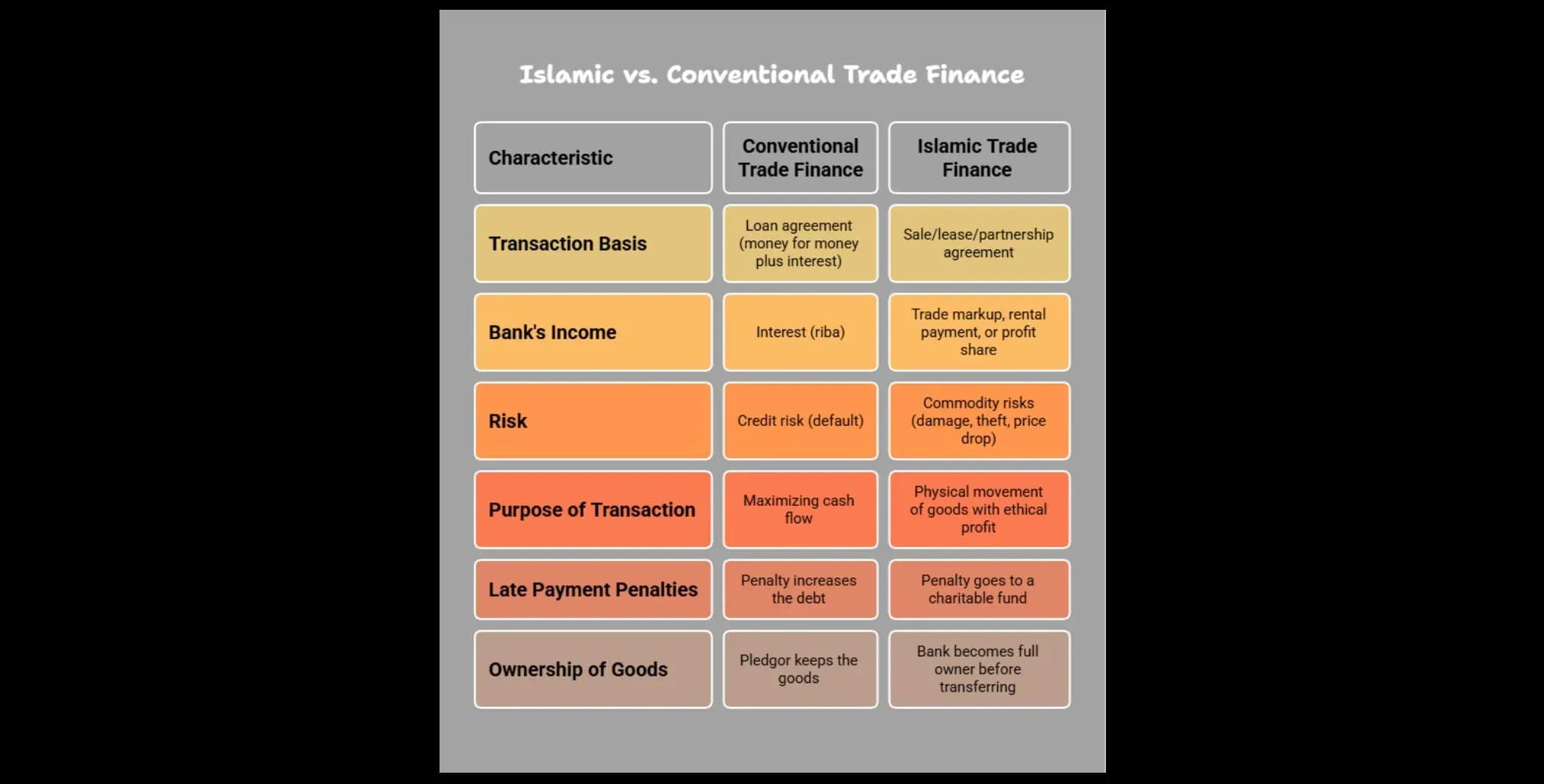
Main differences:
Transaction Basis: Conventional – loan agreement (money for money plus interest). Islamic – sale/lease/partnership agreement.
Bank's Income: Conventional – interest (riba). Islamic – trade markup, rental payment, or profit share.
Risk: Conventional bank does not own the asset; its risk is only credit risk (default). Islamic bank takes on commodity risks (damage, theft, price drop until sale to client).
Purpose of Transaction: Conventional loan – maximizing cash flow. Islamic financing – physical movement of goods with ethical profit.
Late Payment Penalties: Conventional – penalty that increases the debt. Islamic – penalty goes to a charitable fund; bank's income does not increase.
Ownership of Goods: Conventional factoring/loan against collateral – the pledgor keeps the goods. In Islamic Murabaha, the bank must become full owner before transferring to the client.
created by Napkin
Advantages and Limitations for Businesses
Like any financial model, this type of financing has pros and cons.
Advantages
Total transparency: Markup fixed at contract signing, no hidden fees or floating interest rates.
Sharia compliance: Critical for entering GCC markets (UAE, Saudi Arabia, Qatar) and Malaysia, where an Islamic certificate is a pass for government procurement.
Access to Islamic markets: Many funds in Qatar and Brunei work only with Islamic instruments. Obtaining Sharia-compliant financing gives access to their liquidity.
Reduced debt burden: Since the bank's income is a profit share or markup on goods, not a floating interest rate, it's easier for businesses to budget.
Limitations
Complexity of structuring: Each transaction is a legal construction set. You need to document the transfer of ownership, risk assumption moments, and goods return. This takes time and money.
Need for Sharia control: Transactions with Islamic banks require a Sharia compliance check. The format depends on the bank, jurisdiction, and Sharia board requirements. In Russia, there are few such boards (e.g., boards at Express-Volga bank or new players), plus international auditors (AAOIFI) are expensive.
Industry restrictions: Automatic refusal for businesses involved in haram. If you trade in non-halal animal skin or excise alcohol – the door is closed.
Interesting to read

Factoring Has Stopped Being a Paper-Based Game?
From tokenized Treasuries to direct invoice financing. Real use cases, active protocols, regulatory moves, and the gap between on-chain efficiency and legal reality.

How to assess commodity flows for tokenization: legal framework
Three criteria: legal soundness, regulatory fit, economics. Edenex POV
How to Choose the Right Financing Model
Here's a quick algorithm for choosing a model: (Napkin AI illustration: Choice of Financing Model)
Conclusion
Islamic trade finance is not an exotic niche but a tool for medium and large businesses that value predictability and want to work with capital from the Persian Gulf countries. Yes, it requires abandoning the familiar word "loan" and delving into commodity chains. But in return, you get transactions with real collateral (assets), risk sharing, and access to ethical money.
Main advice: Do not try to adapt classical credit agreements "to be Sharia-compliant" – this almost always leads to haram. Use ready-made models as a base and be sure to involve an independent Sharia expert at the structuring stage.
What is Islamic trade finance?
It is financing foreign or domestic trade transactions based on Sharia principles, where the bank's income is generated through trade markup (Murabaha), leasing (Ijarah), or partnership (Musharakah), not interest.
How does Murabaha differ from a bank loan?
With a loan, you borrow money and buy the good yourself. With Murabaha, the bank buys the good itself, owns it (assumes risk), and resells it to you. Your debt is the fixed price of the good, not the loan amount plus interest.
Which transactions are prohibited by Sharia?
Trading prohibited goods (pork, alcohol, tobacco, weapons), transactions with excessive uncertainty (selling what you don't own), gambling (stock market speculation in futures without delivery).
Can Islamic financing be used in international trade?
Yes, this is one of the main scenarios. Islamic banks actively issue letters of credit for imports using the Murabaha model. For example, for purchasing goods in China or Europe.
Which models are used in international trade?
Mainly Murabaha (documentary operations) and Istisna'a (for financing long-term manufacturing contracts, e.g., shipbuilding). Salam is used less often due to the complexity of controlling delivery from another jurisdiction.
Can an Islamic letter of credit be used for imports?
Yes. It's called a Murabaha Letter of Credit. The issuing bank (Islamic) pays the supplier for the goods or services, then transfers them to the client on pre-agreed terms. An Islamic letter of credit can be used as a documentary instrument, while the financing is structured via Murabaha.
Which model is suitable for purchasing equipment?
Ijarah (Islamic leasing). Especially if the equipment is expensive and quickly becomes obsolete. The bank owns it while you pay rent, and breakdown risks (excluding operational ones) are on the bank.
Is a Sharia board review necessary?
Yes, to validate the transaction as Halal. Islamic banks and institutional investors require Sharia compliance confirmation, especially in cross-border and structured transactions.
What are the risks of Islamic trade finance?
Credit risk (client doesn't pay) + commodity risk (until transfer to client) + non-compliance risk (a court deems Murabaha a hidden loan if there was no real ownership of the good by the bank). Also, the risk of the Sharia board rejecting the deal at signing.